Introduction
One or both parties can get married through marriage by proxy without personally attending the wedding ceremony. Rather, the missing partner is replaced during the real marriage ceremony by a third party with legal permission. Despite the fact that California does not permit proxy marriages due to California Family Code regulations, proxy weddings have a long history and are still used for significant purposes today.
In actuality, there are legitimate, pressing reasons why people inquire about marriage via proxy. Tight deployment timelines that conflict with wedding plans are a problem for California-based military personnel serving overseas. Marriage timing has an impact on visa applications. International couples must manage complicated immigration schedules. Some are unable to take part in their own wedding for other reasons. Jail time, travel restrictions, or health problems are a few examples.
The article explains what a proxy marriage is and how the process works legally.
What Is a Proxy Marriage?
When either one or both of the partners have no physical presence for the marriage ceremony, it is known as a proxy marriage. When this occurs, someone else usually represents the missing party. When neither partner is actually present at the wedding, it is known as a double proxy wedding.
In general, the following situations call for marriage by proxy:
- Military service, usually when one side is stationed in a remote area while on active duty
- Imprisonment
- limitations on travel
- The couple lives in a place where it is illegal for them to get married
- Other situations where a couple wants to get married but one or both of them are unable to attend the event in person.
In general, the majority of US jurisdictions prohibit proxy marriage. Proxy marriages aren’t considered legally binding, and both individuals must be present in person. There are a few exceptions, though.
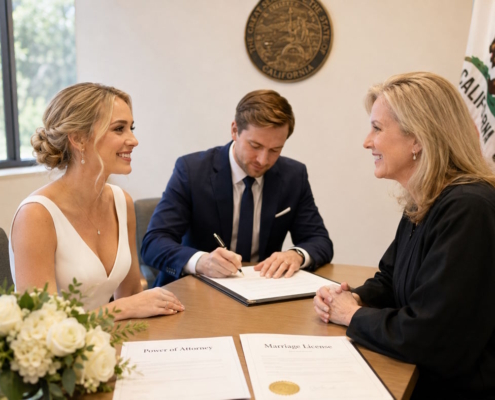
Proxy marriages are only permitted in California for stationed military personnel. More precisely, in California, one individual is given a power of attorney to act on behalf of the grantor. The person with the power of attorney has to be present in person at the wedding and have a signed copy of the primary power of attorney, not a copy. Additionally, the power of attorney paperwork needs to be notarized by a qualified notary and attested by two armed forces personnel.
It is highly conceivable that a proxy marriage carried out in a state where such marriages are permitted will be completely accepted in other states. The union will be recognized as a common law union in some states.
A proxy marriage is voidable. In other words, if the marriage is contested, it may be dissolved. It is still lawful if it is not contested by either side. Another way to put it would be that a marriage is dissolved only if one of the partners questions the validity of the union.
How Proxy Marriage Operates in States That Permit It
Most states do not allow marriage by proxy (including California). Some U.S. jurisdictions still do. Based on whether one or both parties require proxy representation, the procedure differs greatly.
1. Single Proxy Marriages
One spouse stays away from the wedding ceremony, whereas the other participates in a single proxy marriage. A signed power of attorney enabling someone to act in their place is provided by the absent party. In certain situations, states like Kansas, Colorado, and Texas permit this, especially for military personnel who are unable to obtain leave.
Usually, the procedure entails:
- Getting a marriage certificate in the country where the wedding will take place.
- A certified power of attorney expressly for marriage is signed by the absent party.
- The proxy is showing up with the appropriate authorization and identity paperwork.
- The legal ceremony is being conducted by a certified officiant with the necessary witnesses.
- Submit the written marriage license to the county clerk or court office.
2. Double Proxy Marriages
Each spouse is represented by two different people in a double proxy marriage. It allows both partners to be absent. The most widely recognized state that allows this arrangement is Montana. Its long-standing law has assisted hundreds of couples in getting married when their attendance is not possible.
For a Montana double proxy ceremony:
- Authenticated power of attorney paperwork must be provided by both parties.
- Before the person performing the marriage ceremony, each proxy must appear.
- Witnesses must confirm that the marriage was voluntarily consented to by both absent partners.
- The marriage application is processed by the Flathead County Clerk or another Montana county clerk.
- For legal & immigration purposes, certified versions of the marriage license are supplied.
3. Integration of Modern Technology
Many countries will use contemporary technology in conventional proxy marriage processes. Military personnel stationed abroad can complete necessary paperwork using remote online notarization. While proxy representatives actually attend the ceremony, absent parties can virtually participate through video conferencing.
However, state legal obligations cannot be superseded by technology. Video participation cannot take the place of a proxy who is legally permitted to act on your behalf if your state demands physical attendance.
Is Proxy Marriage Permitted in California?
Marriage by proxy is prohibited in California. Both parties must be present in person to receive a marriage certificate. They must take part in the ceremony (California Family Code). Medical emergencies and other situations that would make attendance impossible are not exempt.
Military marriages are one situation in which proxy marriage is permitted under the Family Code. One of the parties to the marriage may designate another person as their proxy through a power of attorney if they are a member of the military, currently stationed abroad, engaged in combat, or otherwise unable to attend the marriage ceremony.
California’s laws governing marriage mandate:
- Both parties’ personal appearance when requesting a marriage license
- Both partners’ physical presence during the marriage ceremony
- Each party gave the person conducting the ceremony their direct approval.
- Verifiable identity and fulfillment of age criteria in person
- Acceptance of Lawful Proxy Marriages from Different Jurisdictions
The most important distinction is that, although proxy marriages are not permitted in California, courts in California will typically accept proxy marriages that were lawfully consummated in another jurisdiction or nation pursuant to the “place of celebration” standard. This means that California will probably consider your marriage to be lawful, whether you got married by proxy in another state or through a legitimate proxy wedding in another nation.
Religious and International “By Proxy” Marriages
Many of the individuals in California are from ethnic backgrounds where proxy marriage is either legally recognized today or has historical significance. Knowing these customs makes it easier to understand why our diverse California community commonly has questions about proxy marriages. Courts may examine what a proxy marriage is, depending on local marriage laws.
1. Examples from History and the World
In many civilizations, proxy marriage has a long history:
- European Monarch Marriages: European nobility often entered into proxy marriages to form political connections. It was between the fifteenth & nineteenth centuries. James IV of Scotland and Margaret Tudor had a proxy wedding in London in 1503. It was before meeting in reality at Holyrood Abbey.
- Modern International Identification: A guardian or authorized agent gives approval on behalf of one party. It is recognized in some nations. They are inspired by Islamic rules, such as those in The Gambia. Traditional ideas about family participation in marriage preparations are reflected in this.
- South Asian customs: When consent is properly documented and witnesses attest to the agreement, nations like Pakistan and India may accept some types of proxy marriage. Family representatives often participate in these ceremonies with the absent party’s express consent.
2. Religious Perspectives on Proxy Matrimony
The acceptance of proxy weddings varies throughout religious traditions:
- Proxy marriages are permitted under Catholic canon law with specific church approval. The Catholic Church acknowledges that exceptional situations may call for proxy representation. It nonetheless demands explicit proof of permission & appropriate ecclesiastical sanction.
- Jewish law permits proxy betrothals in certain circumstances. Rabbinical leaders strongly favor in-person rituals wherever possible. The community’s testimony to the marriage vow and unambiguous agreement are still essential.
- If consent is correctly recorded in accordance with Islamic legal principles, an Islamic Nikah can be completed by an authorized representative. Clear authorization, eyewitness verification, and compliance with Islamic marriage contract criteria are the main prerequisites.
- Variations in civil law vary greatly by nation. Although it may accept legitimate international proxy ceremonies, German civil law forbids new proxy marriages. Civil marriages must be performed in person in France, although overseas proxy marriages are occasionally accepted, provided they are legally recognized.
3. Considerations for California Courts
Sometimes foreign proxy weddings are involved in California divorce or parenting matters. The court often focuses on two primary issues.
- Was the marriage lawful in the jurisdiction in which it took place?
- Is it against California’s strong public policy to recognize the marriage?
The majority of legally executed international proxy marriages satisfy California’s requirements for recognition. Documentation, however, becomes essential. Before initiating any family law action in California, we advise clients with foreign or religious proxy weddings to get all pertinent papers, including marriage agreements, certificates, witness testimonies, and verified translations.
How California Divorce, Property, & Support May Be Affected by a By Proxy Marriage
For the objective of divorce, property distribution, and support, California treats a lawful foreign or non-local proxy marriage in the same way as any other marriage. But proxy marriages might present special difficulties that call for careful consideration of both financial and legal aspects. Lawyers are often asked what a proxy marriage is in international marriage disputes.
1. Issues with Separate vs. Community Property
Although recognized proxy marriages are subject to California’s community property rules, it can be difficult to distinguish between community and separate property when couples live apart following a proxy ceremony:
- Impact of Date of Marriage: Property categorization for assets acquired subsequently is influenced by the formal marriage date. Community property rights are created starting on the date of a proxy marriage in Montana, with one spouse remaining in California.
- Geographic Complications: Following a proxy marriage, tracking asset purchase and classification necessitates a thorough financial study when spouses reside in separate states or nations. For these intricate property partition cases, an experienced CPA is crucial.
- Business Valuation Problems: Careful assessment is required for closely held companies, professional activities, and real estate acquired after a proxy marriage. Each spouse’s participation and the community’s stake in assets obtained during the time must be decided by the court.
2. Division of Retirement Accounts and QDROs
Proxy marriages make it especially difficult to divide retirement accounts using QDRO (Qualified Domestic Relations Orders):
- 401(k) Plans & Pensions: It is vital to prevent IRS fines or plan disqualifications. Specific QDRO language is needed for military retired salary, federal employee retirement accounts, & private 401(k) funds accrued following a proxy marriage date.
- Multiple Jurisdictions: The QDRO must take into consideration various state tax ramifications and plan regulations when one spouse developed a career in California while the other operated in Montana, where the proxy marriage took place.
- Timing Issues: The community’s interest in benefits for retirement is impacted by the marriage date determined by the proxy ceremony papers. The community portion of substantial retirement assets may be diminished by missing or ambiguous proxy marriage records.
3. Typical Conflicts in California Courts
Proxy marriages typically result in particular conflicts in California family law disputes.
- Marriage Validity Issues: A spouse can dispute the validity of the proxy marriage. It is done to avoid paying spousal support or dividing the property. It becomes vital to demonstrate that the marriage complied with all legal criteria in its jurisdiction.
- Missing Documentation: Contact with international lawyers or embassy services is necessary. It is to get certified versions of marriage certificates for foreign proxy marriages.
- Overlapping Wedding Dates: Certain couples have subsequent civil ceremonies in addition to religious proxy rituals, which makes it difficult to determine the true marriage date for maintenance duration calculations.
4. Considerations for Support Calculations
Approved proxy marriages are subject to California’s support rules, although a few things need further consideration:
A. Child Support: Irrespective of the parents’ marital status, California’s guideline computations are the same. However, if a proxy marriage is involved, other documents may be needed to demonstrate parenthood and the marriage link.
B. Spousal Support: The length of the marriage, living standards, and earning potential are taken into account by the court. These computations are impacted by the authorized marriage date of a proxy wedding, especially for:
- Determining the duration of a marriage for long-term assistance
- Living standards that were developed during times of geographic separation
- Claims for reimbursement for investments made in education or a career while living apart
FAQs
1. While I was posted abroad, we were married in Montana through a double proxy. If we file for divorce here, will the California Court accept our union?
According to the “place of celebration” provision, proxy weddings performed in Montana are often accepted by California courts. Double proxy marriages are permitted by a long-standing law in Montana. These weddings are lawful when carried out correctly. You’ll need verified copies of the marriage license & proxy paperwork to prove your marriage in a California divorce case.
2. We’re thinking of a divorce. My husband says that our proxy marriage in Montana is invalid because I couldn’t fly for medical reasons. Can he contest the marriage to avoid providing support?
For circumstances just like yours, Montana expressly permits proxy marriages; medical incapacity to travel is a legitimate basis for proxy representation. The marriage is lawful as long as a proxy ceremony satisfies Montana’s legal standards (appropriate authorization, certified officiant, and witness verification).
When legitimate out-of-state proxy marriages are challenged, California courts frequently reject attempts to evade support obligations. Based on our interactions with judges in California, it appears that they are more concerned with the validity of the ceremony than with the reasons proxy involvement was required.
3. Does California accept proxy marriages that are lawfully performed in my nation?
In general, yes, when the marriage was lawful in your nation at the time it was consummated. Foreign weddings that do not contravene strict public policy are recognized in California, and the majority of legally recognized proxy marriages satisfy this requirement. Documentation attesting to the marriage’s legality in your native nation is required. You can get and translate the necessary paperwork for California court certification with the assistance of a bilingual expert.
4. The date on our proxy marriage license differs from the actual date of our live vow exchange. Which date is used in California to divide property and calculate support?
For all family law reasons in California, the statutory marriage certificate’s official marriage date is used. Regardless of whether you individually exchanged vows via video or had a separate celebration, the date that proxies accepted the license in front of the certified officiant is your legal marriage date. This date establishes the distribution of retirement accounts through QDROs, the categorization of communal property, and the computation of spousal support duration.
There are distinct factual and legal issues in every proxy marriage case. Personalized legal counsel is still necessary to safeguard your rights in California family court procedures, even though these responses cover typical scenarios.