Introduction
California’s wage-and-hour system is built in a way that nothing stands alone. One small change at the bottom usually pushes half a dozen rules above it. When California tweaks the minimum wage, it never stops at that one number. It’s like adjusting the bottom step on a staircase. Suddenly, everything above it shifts too. Job titles, exemption tests, how overtime is calculated, the posters in the break room, even the way your payroll system spits out calculations. All of it starts moving.
That’s exactly what’s about to happen again with the California Salary Threshold 2026. With California raising the minimum wage to $16.90 per hour in 2026, employers are going to feel that ripple everywhere.
Firms in California have to match their processes to a new level to reduce risk and maintain compliance.
Quick points
- With the higher wage floor, employers will have to take another look at pay structures. It is to ensure that nobody ends up under the legal minimum by accident. It happens more often than people think.
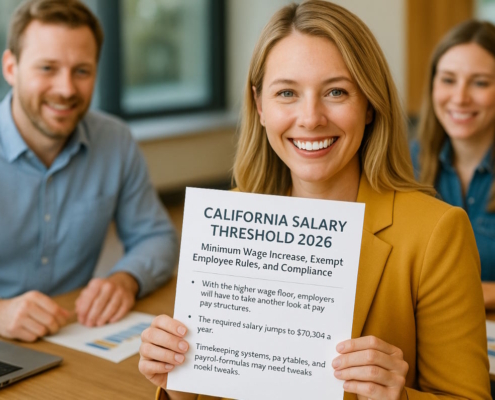
- The minimum wage sits at the bottom of the whole white-collar exemption system. That number going up means the exemption threshold goes up with it. The required salary jumps to $70,304 a year. This number sits at the heart of the California Salary Threshold 2026.
- Timekeeping systems, pay tables, and payroll formulas may need tweaks. And so do the posters and notices that employers are legally required to share with employees.
This isn’t busywork. California takes wage compliance seriously.
The California Salary Threshold 2026 for Exempt Employees
The salary level for most white-collar exemptions goes up with the minimum wage increase. The rule is simple. California ties exemptions for executive, administrative, & professional employees to a simple formula:
Salary = 2× state’s min wage × 40 (hours per week) × 52 (weeks).
The minimum salary = $70,304 a year.
That means employers should probably double-check two things:
- Does the employee actually do exempt-level duties? (California has strict standards for this.)
- Are they paid at or above the new salary threshold?
If either one fails, that worker cannot be classified as exempt.
Commission-based exemptions also hinge on the minimum wage. Under Wage Orders 4 and 7, commissioned sales employees must earn more than 1.5 times the minimum wage and must get more than half of their total pay from commissions. With the new wage, that number becomes $25.35 per hour on an earnings basis. Employers will have to make sure their compensation plans still meet the rule.
Union Agreements That Rely on Minimum Wage Formulas
Some carve-outs in collective bargaining agreements also depend on the minimum wage being a certain percentage higher. For example, certain overtime exceptions require employees to earn at least 30% more than the state minimum wage.
With the 2026 minimum wage, that threshold becomes $21.97 per hour.
Any union contract that relies on that ratio must be recalculated—or it will fall out of compliance automatically when the new rate kicks in.
Piece-Rate Pay Programs
Piece-rate systems are complicated even on a normal day, because California requires employers to:
- Separately pay for nonproductive time, and
- Separately pay for rest breaks.
- At no less than the minimum wage, or in the case of rest breaks, the higher of minimum wage or the employee’s average hourly earnings.
A bump in the statewide minimum wage raises the floor for both categories. So employers using piece-rate pay will need to go back and confirm their formulas, codes, and payroll setups are ready for the new rate.
Reporting Time Pay and Split-Shift Premiums
Another place the minimum wage quietly affects calculations is reporting time pay and split-shift premiums.
For split shifts, the state requires an extra hour of pay at the minimum wage. If an employee already earns above minimum wage, the difference can be applied to that premium. But when minimum wage increases, the math changes—all of it.
This will matter most to hospitality, retail, food service, and any business with irregular scheduling. Employers should check that their scheduling systems and payroll logic handle the new rates automatically, because errors here are extremely common and expensive.
Required Workplace Postings and Wage Notices
California’s posting requirements are tied to the minimum wage, too. Employers must display:
- The correct Industrial Welfare Commission (IWC) wage order
- The general minimum wage order
These have to be up to date. So once the 2026 rate becomes official, old posters must come down, and new ones must be put up where employees can actually see them.
Hiring notices also need attention. California requires that employees receive written information about their pay rate and certain allowances at the time of hire. When pay changes, the employer must provide updated notice—unless it already appears in a timely, legally compliant wage statement.
In other words:
If a pay rate changes, a written update must follow.
City-wise Minimum Wage Ordinances
Many California cities have higher local minimum wage rules. They adjust independently of the state.
Employers have to follow the highest applicable minimum wage. This becomes important when tracking the California Salary Threshold 2026.
A rise in the statewide rate doesn’t override higher city rates—it simply lifts the baseline everywhere else. Businesses operating in multiple cities may want to update their “rate map” and make sure each location is aligned with the correct local wage.
What Employers Should Do Now
Adjusting to the new minimum wage requires real changes in payroll systems & HR processes.
Employers must:
- Update pay tables in payroll and timekeeping systems
- Recheck overtime logic, split-shift rules, and regular-rate calculations
- Reprice exempt roles to match the California Salary Threshold 2026
- Review any commissioned or union roles tied to minimum wage formulas
- Replace all required workplace posters
- Issue updated wage notices wherever necessary
- And, after the increase takes effect, audit at least one pay cycle to make sure everything is working correctly
The goal is to avoid avoidable mistakes—because once the wage goes up, every error becomes more costly.
Why All of This Matters
California’s wage-and-hour system isn’t something you can “fix once and forget.” A change in the minimum wage lifts several other legal requirements with it. The present systems might fall out of compliance next year unless they’re updated.
A careful, end-to-end review before the new rate becomes active is the safest way to avoid complaints, penalties, & lawsuits.
And given how interconnected California’s wage rules are, that review is worth the time.
Conclusion
California Salary Threshold 2026 will reshape the salary requirements. The increase may look like a simple adjustment—just a new number on paper—but for California employers, it’s one of those changes that spills into every corner of payroll and HR. It reshapes classifications, forces salary bumps for exempt workers, and requires updates to forms, notices, and even the software that handles the back-end math. Businesses that prepare early usually handle these transitions smoothly, because they’ve already audited their pay structures and caught any issues long before the law kicks in.
Those who wait often find themselves rushing, fixing mistakes under pressure, or dealing with wage claims later. None of that is necessary. The new $16.90 floor is predictable. The salary threshold is predictable, & the compliance steps are pretty straightforward. A thoughtful, end-to-end review now saves headaches later. It helps employers start 2026 with cleaner systems, clearer policies, and fewer surprises.