Introduction
Job applicants often wonder, “Does a felony from years ago still show up on a background check in California?”
Yes, it does. If you don’t actively try to clear it, it basically stays forever. And that can mess with a lot of things: jobs, renting a place, licenses, school applications, all of it.
A landlord or employer runs a check, they see the old conviction, and even if you’ve moved on with your life, they may not treat you fairly. That’s the frustrating part.
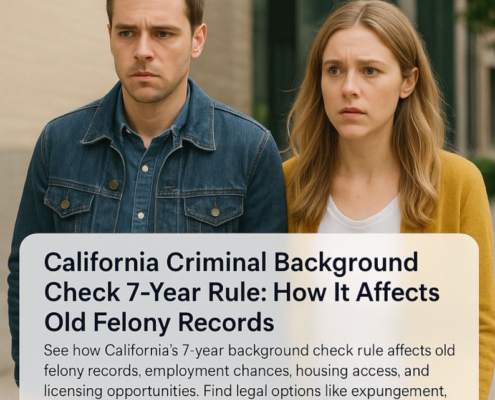
California doesn’t treat criminal records the way credit reports work. People talk a lot about the California Criminal Background Check 7-Year Rule. There’s no seven-year timer in this case where things just fall off. A conviction record just sits there.
So the best way to keep an old felony from appearing is to actually get it cleared using one of California’s legal remedies.
The duration for which a felony stays on your California record
If you don’t do anything about it, it stays permanently. Nothing makes it disappear by itself. No time limit. No automatic removal.
This is in contrast to a credit report entry that disappears after an extended period. Although recent “Clean Slate” legislation gives automatic remission for certain crimes (more on it later), California law doesn’t automatically expunge adult felony files after a predetermined period of time. Until you actively get legal relief, the felony remains right there on your public criminal record.
This can create problems. Jobs, housing, licenses, schooling, almost every part of life can be affected because that piece of your past keeps showing up. A landlord or employer might see the conviction, not ask questions, and simply decide “no.”
Long after they have completed their sentences, many Californians with prior convictions continue to endure stigma & practical obstacles. The good news is that there are ways to lessen the effect of a criminal record in California. You can usually clear your history so that most individuals won’t see the sentence, even if real “erasure” (a permanent deletion) is not accessible.
California Criminal Background Check 7-Year Rule
Probably you have heard about “The California Criminal Background Check 7-Year Rule”. There is a cap on the number of prior convictions that can be reported in California job background checks. For criminal convictions, the majority of companies’ background checks are limited to seven years prior. Employers employing external background check agencies are generally prohibited by California law from obtaining or taking into account convictions that are more than seven years old.
For instance, a background check from a private company shouldn’t reveal a felony you were found guilty of 10 years ago if you don’t have any fresh criminal convictions.
But there are several important disclaimers:
- Exceptions: The seven-year limit does not apply to certain occupations. For example, positions in justice systems or other highly sensitive fields, or those with specific wage limits, may lawfully evaluate your entire history beyond seven years. Additionally, your whole record may be included in the assessment if an employer conducts a fingerprint-powered Live Scan check (common for government positions, hospitals, educational institutions, and law enforcement).
Even yet, employers are generally prohibited by California’s labor regulations from taking sealed or expunged convictions into account when making hiring choices.
- Public Records: The record may still be available in public records from courts if it hasn’t been wiped out, even if the background investigation business doesn’t report an old felony. It might be discovered by astute landlords or others looking through court records. To put it another way, the seven-year restriction restricts the information that consumer reporting companies can give to companies, but it fails to erase a conviction from the database.
In conclusion, if you haven’t cleaned an old felony, it may still appear on a background check.
According to the California Criminal Background Check 7-Year Rule, convictions older than seven years are not listed in California’s regular job checks. Public records & law enforcement, or specific high-security screenings, will still see everything.
What can you do to remove a felony in California?
California gives you a few ways to deal with old convictions. These are called post-conviction remedies.
The three main ones are:
- A Governor’s Pardon
- A Certificate of Rehabilitation
- Expungement (also called dismissal)
Each one works differently and has different requirements. They affect your future in different ways.
1. Felony Dismissal (Expungement)
Expungement is the most common option. It basically changes your record to show that the conviction was dismissed by the court. In theory, unlike several other jurisdictions, California does not provide full “expungement,” or the total wiping of the record. California offers a procedure through Penal Code 1203.4. It allows you to satisfactorily finish your sentence and then ask the court to have a conviction dismissed.
The process of expungement involves submitting a Petition for Dismissal. Your guilty submission or judgment is overturned, and the dismissal is recorded if the court approves it. In essence, the court amends the record to reflect the case’s dismissal (it frequently appears as “dismissed in the best interests of justice” or “dismissed according to PC 1203.4”). After that, you become free from “all penalties and impairments” brought on by the conviction.
What exactly an expungement accomplishes: An expunged felony is seen as being off the books for the most part. The conviction would no longer appear on routine background checks conducted by landlords or private employers.
Employers are actually prohibited by California law from inquiring about or using erased convictions in their hiring choices. On the majority of employment applications, you are legally allowed to respond “No” when asked if you were convicted of that felony. Clearing your record can open doors: for housing, for jobs, for all kinds of opportunities. Because once a felony is expunged, it generally won’t hold you back the way an open, visible conviction does.
It’s important to keep in mind that expungement doesn’t wipe the court record off the face of the earth. Law enforcement agencies & immigration authorities can still see it. The case file still sits where it always did. There are situations (after expungement) where you have to disclose the conviction. Certain government jobs, specific professional licenses, anything tied to law enforcement, and more.
You can clarify that the court eventually dismissed it. Expungement doesn’t remove sex-offender registration requirements. It doesn’t restore gun rights. Expungement isn’t a magic delete button for your past. But it is a powerful tool to clean up your public record and improve your chances moving forward.
Expungement Qualification
People who received no state jail time for their felonies were previously covered under California’s expungement law.
Generally, you could apply for expungement if you were found guilty of a felony and finished probation (or incarceration and probation). You were ineligible if you had a state jail sentence, but new legislation (such as SB 731 from 2023) has made record clearing available in a lot more circumstances.
Now, after serving out their whole sentence and abstaining from crime for a certain amount of time, even those with certain state prison offenses may ask to have their record sealed. Serious sexual offenses & certain other groups that cannot be expunged are the main exceptions (for instance, some sexual or violent felonies are not acceptable for expungement).
It’s always smarter to double-check with a lawyer, or at least look through the court’s self-help guides, to figure out whether you actually qualify. Usually, if you’ve completed whatever the court told you to do, you’re not dealing with any current legal issues, and your conviction isn’t on the “no-expungement” list, then your chances are honestly pretty solid. And don’t forget, even if you slipped up on probation or had a few issues, the judge can still grant it if they believe it serves justice. So it’s worth trying.
Timeline & procedure: Getting an expungement isn’t complicated in theory. It’s mostly about gathering the right forms and putting them in front of the court. You file a petition and add a proposed order. You take it to the courthouse where your case was originally handled. So if your conviction was in Los Angeles County, you’d end up back at the same Superior Court building where everything happened. And depending on the case, the judge might even approve it without ever calling you in for a hearing. Objections are uncommon.
In California, the entire process of expunging a felony usually takes many months.
The court’s processing and approval of an expungement could take an average of between 90 and 120 days. Certain courts (and earlier cases) may take longer, particularly if the court is occupied or records are archived. It is common for an expungement procedure to last three to four months or longer in Los Angeles due to the city’s extensive and backlogged court system.
Courthouses in Los Angeles, for example, operate at different speeds. According to one source, some courts in the L.A. area can process new expungement matters in 6–8 weeks, whereas older cases or crowded courts might require several months. It may take several months for the paperwork to be signed. The California Department of Justice is going to update the state’s criminal record & background check databases after the court amends its records and notifies them.
Example: You were found guilty of a criminal offense in Los Angeles ten years ago. You served your probation. You have not committed another crime. If you do not take action, that offense remains on your record indefinitely. It can be discovered by anyone looking through court documents.
The California Criminal Background Check 7-Year Rule might limit what some employers see, but it doesn’t protect you everywhere, and it may prevent it from appearing on a simple employment check after ten years, but you wouldn’t want to depend on that. You can have the case dismissed by filing an expungement petition.
The conviction won’t show up when an employer conducts a background check because the court must keep the case hidden from the public and background check businesses once it has been dismissed. You are able to apply for jobs without being hindered by past offenses.
For this reason, the first & most effective choice to consider is usually expungement.
2. Certificate of Rehabilitation: Taking It a Step Further
What happens if a straightforward expungement isn’t possible for your felony? Or what happens if you want advantages and certainty that go beyond being fired? A Certificate of Rehabilitation helps in this situation. It is a court order that certifies that you have undergone rehabilitation after a conviction. People who have served time in state prison or those who are unable to obtain an expungement can utilize it as a first step toward a pardon.
A Certificate of Rehabilitation in California doesn’t permanently seal the record or remove the conviction.
Instead, consider it a formal declaration from the court that you are now a responsible, rehabilitated citizen of society. It has a number of advantages. For starters, the court’s decision is sent to the governor’s office as a pardon request, and a Certificate of Rehabilitation instantly turns into a request for a governor’s pardon.
Additionally, the certificate can assist with professional licensure and job prospects; a COR may alleviate certain licensing constraints and is favored by certain state licensing boards. Additionally, a Certificate of Rehabilitation may, in some circumstances, release you from the requirement to register if you are a registered sexual offender (for specific offenses).
However, a Certificate of Rehabilitation doesn’t give you the right to leave out your conviction on employment applications since it does not conceal your conviction. The conviction is still on file, in contrast to an expungement (although with a notice that you are rehabilitated). Rather than clearing the record, it’s more of an indication and formal acknowledgment of your turnaround. It is relevant for pardons or for people who can’t get their crimes expunged.
Applying for a Certificate of Rehabilitation
This route is mainly meant for people who actually served time in jail or for anyone who doesn’t qualify for a regular expungement (Penal Code 1203.4). It’s usually used by folks with certain misdemeanor sex offenses or by people who have had felony convictions that ended with state prison time. To qualify, the basics are pretty straightforward, even if the rules feel a bit technical:
- You need to have lived in California continuously for a set number of years, usually five years, before you even apply. And depending on the offense, you’ll need a few additional years after getting out of custody.
- You must be completely off probation or parole. And you can’t be locked up for any new case.
- And, maybe the most important part, you have to show that you’ve genuinely rehabilitated. That means staying out of trouble for a long stretch. The exact number of years depends on the conviction (somewhere between seven and ten years after your release).
There are specific eligibility requirements. Those with merely misdemeanors (except for some sexual offenses) do not require a COR. Some crimes of extreme severity (such as some sexual felonies or life in prison) do not qualify.
Procedure: Obtaining a Certificate of Rehabilitation requires a little more work. The highest court of the area in which you reside (or where you have been found guilty) must receive your petition.
For example, there is no registration cost for a COR application in Los Angeles County if you file in the Los Angeles Superior Court. A hearing before a judge will be scheduled by the court. You need to provide evidence of your rehabilitation. References or community service can be useful. Your petition may be supported or opposed by the district attorney. You are requesting that the court confirm that you are now a law-abiding citizen.
The timeline can sometimes be longer. It may take many months, or even a year or more in certain situations, from the moment you apply to the hearings and conclusion. This is influenced by the probation department’s or the district attorney’s (in certain counties) investigation and hearing scheduling.
Although it’s not a quick remedy, the results can be highly satisfying. Given the degree of difficulty, Los Angeles County actually offers aid to applicants for a Certificate of Rehabilitation via the Public Defender’s office. If you are unable to pay for legal representation, you are entitled to seek assistance from a public defender for a COR. Since a compelling presentation might help persuade the judge, many people employ private attorneys for individualized advice.
You effectively leave with a court order declaring your rehabilitation if the court awards you a Certificate of Rehabilitation.
Certain rights are reinstated, such as the civil rights of nationality that were lost as a result of the conviction; however, it does not reinstate the right to bear arms or the ability to simply state “no conviction” on job applications. Crucially, the court will send the certificate to the governor as a request for a pardon. Additionally, you will obtain a signed certificate that you can present to licensing boards or prospective employers as proof that the court has approved of your rehabilitation.
3. The Final Stage of Relief: The Governor’s Pardon
The highest degree of relief from a criminal conviction is a governor’s pardon. A pardon from the governor is a formal pardon for your offense. A pardon is the state’s acknowledgement that you have repaid your obligation to society and have behaved honorably ever since. It can also restore a number of privileges, including the right to bear arms in certain situations (if it expressly states so).
A pardon provides the only means to completely restore one’s legal status for numerous individuals with past felonies, particularly those who can’t be purged. Before being eligible for a pardon in California (assuming you still reside there), you usually need to get a Certificate of Rehabilitation from a court. As previously stated, the Certificate of Rehabilitation instantly initiates a pardon petition on your behalf. Although it is less usual, you may apply straight to the governor for a pardon if you aren’t eligible for a certificate or if you reside outside of California.
What a pardon accomplishes: It adds a notice that you were forgiven, but it doesn’t seal or remove the conviction from the record. It frequently restores privileges that a felon would not ordinarily enjoy, such as the ability to be placed on jury duty, the right to own weapons (except in certain situations like convictions concerning firearms), and the ability to hold certain employment or licenses.
Additionally, it formally declares that you have shown rehabilitation. Background checks will still show a pardoned conviction, but an employer or authority will also notice that you have been pardoned by the state’s highest power, which can significantly lessen the negative impact.
How to obtain a pardon
The Board of Parole Hearings and the Governor’s office will examine your case when you receive a Certificate of Rehabilitation (if you qualify). They might look into it. A pardon is not guaranteed; governors usually give them out rarely and usually only to people who have demonstrated years of honorable behavior.
A pardon decision may take many months, an entire year, or longer to make. It’s somewhat of a waiting affair. California governors have pardoned a number of individuals in recent years. They are those with long-standing convictions and who have changed their ways. The pardons come on holidays or towards the end of the year.
A pardon is difficult to obtain. It is worthwhile for people with a criminal record who are unable to reach certain objectives (working in a field that prohibits felons). Even applying for one through a Certificate of Rehabilitation can be beneficial.
Los Angeles Overview: L.A. County felony record clearance
Los Angeles has particular considerations for removing felonies.
- Significant Number of Cases: Los Angeles County handles an enormous number of requests for expungement & record-clearing. This implies that the procedure can be longer than in regions with fewer people. Expungement applications in Los Angeles generally take several months to be determined, sometimes more if the court schedule is full. It is advisable to file immediately as you are qualified and to wait patiently for the court to process your case (or have your lawyer follow up).
- Court Procedure: Unless there is an objection or a difficulty, a judge in the Los Angeles higher court may evaluate expungements (applications for dismissal) without holding a hearing. The court may schedule a hearing if you have several cases or a prior conviction. Prepare yourself for that eventuality, although many removals can be obtained without you having to show up in court, particularly if you have a lawyer handling it.
- Local Programs: LA County has demonstrated support for record-clearing, particularly with regard to prior minor offenses. The County District Attorney’s Administration made the decision to dismiss over 66,000 convictions related to marijuana (felonies & misdemeanors) that date back decades. The goal was to comply with the regulation and provide people with a new beginning.
This cleared the felony records of more than 20,000 individuals. It was among the highest in the CA for clearing cannabis convictions. It suggested a local trend favoring second chances. Los Angeles judges and prosecutors are becoming more receptive to attempts at record clearance and rehabilitation.
- Public Defender Support: The LA County Public Defender’s office has a record-clearing unit, as previously indicated. They even aid in obtaining Certificates of Rehabilitation for qualifying folks who are unable to pay for private counsel. The local emphasis on reentry support is reflected in this.
Even if you are dealing with an attorney on your own, it is still beneficial to know that assistance is accessible and the system is used to these petitions. In any circumstance, having informed assistance – whether using the Public Defender or a skilled private lawyer – helps make the whole thing smoother.
- Potential Barriers: One issue some people confront in Los Angeles is locating historical records. With earlier felony cases (such as those that are more than twenty years old), the records might be in repositories or on film. This may cause the expungement procedure to take a long time. An attorney can aid by ensuring the request has as much information as feasible (case numbers, timeframes). It can assist the court in identifying the record.
Court costs for submitting expungements may also be taken into account. The Los Angeles Superior Court traditionally levied a cost for submitting a dismissal petition (about $120) for specific cases; however, policy can change, and waivers of fees can be obtained if you are unable to pay the amount. (By contrast, no costs are levied for submitting a Certificate of Rehabilitation or amnesty application in California.)
Residents of Los Angeles can generally get relief, but because of the volume, you can anticipate that the process will take some time.
The positive aspect is that L.A. courts and attorneys usually comprehend these statutes and, in many situations, encourage individuals moving on from prior convictions – particularly when you’ve proven rehabilitation. Since there are several courthouses in Los Angeles, each court may treat cases somewhat differently, so having a knowledgeable local lawyer is helpful.
The timetable and legal procedure for clearing a crime
In California, clearing a criminal record can have a profound impact on one’s life. It involves following legal procedures and having a lot of patience.
- Expungement: You can file for an expungement after you finish probation. That’s really the starting point. The whole thing usually takes about two to four months. Sometimes faster. Sometimes slower. It depends on the court’s backlog and how quickly your case moves from one desk to another. No set rhythm to it. Once the judge approves it, the conviction is dismissed. And after that, regular background checks usually won’t pick it up anymore. If you qualify, this is the simplest route. The quickest one, too. A clean, straightforward way to clear things up. California Criminal Background Check 7-Year Rule limits what consumer reporting agencies can show.
- Certificate of Rehabilitation: This one takes longer. You have to qualify first. That usually means waiting out a specific period after finishing your sentence to actually show rehabilitation (often seven to ten years). It depends on the type of offense. The process involves collecting documents, sometimes lining up character references, & then submitting a petition for the court to review.
The court may mandate an inquiry or report prior to the hearing; thus, it may take many months or an entire year to receive a hearing and a judgment. The certificate initiates a pardon application right away if it is approved. In the interim, the certificate alone is a useful credential, but this approach requires patience.
- Governor’s Pardon: Once you have completed the Certificate of Rehabilitation procedure, you basically wait for the Office of the Governor to act. There is no defined timeframe. It could be several months or longer. You make a request to the Governor & Board of Parole Hearings and stand by in a similar manner if you apply straight for an amnesty (without a certificate, in some situations).
Pardons are more irregular. Not every applicant is granted a pardon; some may be granted one within a year, while others may take several years. It’s the last stage, and while not everyone is able to get this far, those who must should pursue it with the hope that it will be a long-term objective.
Remark on the clean slate reforms in California
California has enacted laws (such as SB 731 and AB 1076) that instantly seal or dismiss particular convictions once individuals have served their sentences and abstained from crime for a predetermined amount of time.
For instance, starting in 2023 (July), many mild, minor felonies are meant to be effectively removed from public view once you’ve completed your sentence and have not committed any new crimes for four years.
225,000 individuals became eligible for auto record clearance of previous felonies (2024). This automatic remedy should eventually erase certain old felonies from criminal record systems without people having to petition. The implementation of these regulations is still in progress. Some aspects were postponed.
You may verify your record if you believe you might be eligible for automatic clearing. Not all situations will be detected by the system right away. Until you confirm, don’t assume it’s cleared. For many, it is still desirable to file for expungement or alternative options in the interim rather than patiently waiting for the state to take action.
Take charge of your records
Having an old crime on your criminal history can feel like a burden on your entire existence. In California, that burden does not have to be with you forever.
Whether it’s been seven or twenty years after you were convicted, you have choices to diminish the effect or even remove it from the public’s attention. Most people have an opportunity to start over in the view of the public and employers through expungement. A Governor’s Pardon and Certificate of Rehabilitation might offer respite and acknowledge your rehabilitation in more difficult situations. Additionally, it is now simpler than ever for individuals to get behind their previous transgressions due to recent revisions in California law.