Introduction
Administrators and managers are already knowledgeable about the purpose and objectives of training the employees. They are usually in line with the mission, vision, and corporate goals.
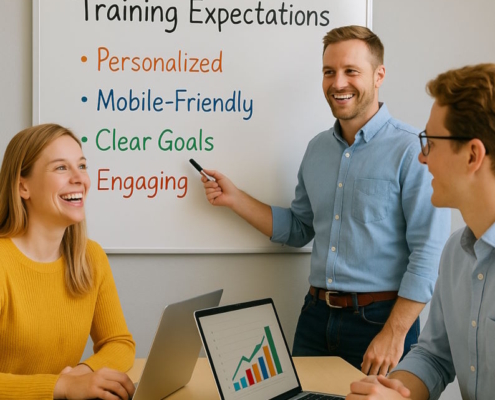
However, contemporary workers also have certain training expectations regarding the program they participate in. Personalized lessons, mobile device accessibility, and peer collaboration are just a few of the learning standards they want. Teachers have an obligation to address these legitimate needs.
This will ensure that employees learn in the most optimal manner and companies attain the ROI (return on investment) as a result of training and development. By nurturing the learning and development of employees in a manner that is appropriate to them, chances are high that the employees will be motivated and happy at their workstations. Eventually, you are to expect career growth and an increased retention rate.
In light of this, we examine some of the typical corporate training expectations that most staff members have in this post, along with the best ways for you as a trainer to fulfill them.
To find out, keep reading.
Important Learnings
- Transform goals into role-based results and disclose them up front to match expectations and encourage buy-in. Employees want clear goals that are relevant to the actual world.
- They appreciate mobile, customized, and straightforward experiences; to reduce friction and respect learner choice, assess your collection for adaptability, microlearning, and established milestones.
- Interactive material, teamwork, and continual support increase engagement; add conversations, mentorship, and continuous improvement of skills to increase confidence, retention, and quantifiable return on investment.
Ten Training and Development Expectations and How to Fulfill Them
Some common expectations learners have about company training programs can be explained by these training expectations from attendees, and advice on how to fulfill them.
- Learning Objective Communication
Clear goals and objectives for learning serve as a guide for teachers and training administrators in a formal training for staff scenario. They are all spending their time & efforts to complete certain objectives.
Students want to know the reason why they are participating in the program. You have to be open at this stage.
How to Meet This Expectation: Be clear on what your training goals are and inform your students in advance about them. You are supposed to explain how the realization of those goals will result in greater efficiency, performance, and career growth.
Since students are aware of the intended results and what is required of them to achieve them, setting standards for training with these objectives will guarantee active involvement.
- Anywhere, Anytime Education
It is estimated that about 73 percent of employees access their work-related information using their mobile phones (like checking their emails). They prefer viewing online training content, e.g., short films and tests, by using their own devices. They expect the content to be available on any system, on the go, and self-paced as per appropriate scheduling.
Education should be like a handbag, at their disposal, whether they are at home and on the road, or in a line, or even having a cup of coffee in a coffee shop, the idea is the same.
How to Meet This Expectation: As mobile phones are the tool of choice, use a mobile-first approach. Additionally, make use of e-learning resources with a responsive layout, which automatically modifies the material arrangement according to the kind of device that students are using. You can also use microlearning, which is simple and quick for learners to understand, to meet these employee training objectives.
- Individualized Experience
Personalization of products and services is an approach that many large corporations are now pursuing. It is crucial for lasting business success and keeps clients engaged by meeting their demands according to their specifications.
Similarly, employees expect to get a personalized touch during the training process to meet their learning needs. No two students study at the same pace and style. They want businesses to understand this fact.
How to Meet This Expectation: Provide your employees with a chance to choose their own path of learning. It will be based on their interests, strengths, and weaknesses. To make it easier to create a plan of action for them, you can assess them using a pre-training evaluation test.
Instead of forcing people to take classes and exams that have little to do with their jobs, you can give training materials depending on their job duties and responsibilities. All of the information will enable you to address their unique learning requirements.
- Goal-Setting Ease
Many workers anticipate having some latitude in establishing both immediate and long-term objectives for their professional growth. Although their supervisors already convey the overarching corporate objectives, staff members would prefer to modify them to suit their own requirements. They might want to concentrate more on this subject than others, or they might want to go over ideas again until they get them.
How to Achieve This Goal: Allowing your staff to identify their learning objectives, milestones, and a specific plan for achieving them within a given timeframe is one of the finest employee training strategies to meet such expectations. Encourage them to continue exploring at their own speed. Allow them to select training materials and look for assistance to close their knowledge gaps.
They can find the gaps by doing a self-evaluation. Maintaining your learners’ motivation by meeting this employee training requirement is equally important for ensuring that they stay on course and finish their training.
- Link to Actual Situations
It’s acceptable to keep content organized, consolidated, and readily available. However, that wouldn’t be sufficient unless you paid attention to the type of material you offer. For instance, to guarantee that participants’ training expectations are fulfilled, you should always make an association between what you teach and its application in real life.
Workers are aware of the impact that real-world scenarios and examples have on their understanding. Thus, this is an additional expectation people have of any training course.
How to Fulfill This Expectation: If you’re providing OSHA-style safety training, be sure to provide your staff with how-to films and practical examples at the workplace.
They ought to comprehend how information and skills are used in practical situations. They are able to relate to many safety scenarios and understand what they may accomplish to protect others as well as themselves.
- Interactive & Captivating Content
One of the most prevalent demands for employee training is this. From one-way presentations and listening passively in conventional schools to interactive designs that interact with participants, learners have certainly come quite a distance. Students want this type of instruction, especially since it’s enjoyable.
Students demand more and more of this component in training since they are completely engaged and engage their minds.
How to meet this expectation: In your training courses, gamification, walkthroughs, videos, polls, surveys, and quizzes may be used. This will start and maintain a high interest that will increase learning and productivity.
- Easy & Efficient Instruction
Employees have a right to expect professional training programs to be straightforward, well-structured, and unambiguous. They anticipate that the material will be organized so that they can quickly understand what they need to learn and how it relates to the job they do.
How to Fulfill This Expectation: This has a lot to offer with the instructional designers or course developers you hire to plan and carry out your organization’s training. Keep the material brief, pertinent, and task-oriented whenever you can. Discover what your students prefer to learn and what goes best for them.
- Cooperative Social Education
Online education may create a sense of loneliness. Students are geographically dispersed, remote, and engaged in asynchronous learning. To compensate for the unavailability of face-to-face meetings, employees often expect to have virtual contacts with other employees and training supervisors.
This is a personal wish that can promote a good online learning atmosphere.
How to satisfy this Expectation: Provide a social educational session where mobile cooperation of the participants of a training can be promoted. To promote teamwork and cooperation, include social or collaborative events. Online collaboration features are supported by some of the top LMS systems.
On social media platforms, where people spend a large portion of their time these days, you can also promote collaborative learning.
- Continued Assistance
Employees cannot be expected to handle things on their own, particularly while you are training new staff. One aspect of the scheme involves allocating online training courses. Because they occasionally require assistance, learners anticipate continuous support from their teachers.
How to Fulfill This Expectation: A knowledge foundation, mentoring, regular updates and feedback, collaborative learning, and other strategies can all be used as forms of support. Giving your staff all the support they require to get the most out of the internet-based courses and other educational resources is crucial.
To guarantee an increased participation level in any business training, such assistance is also essential.
- Continuing Education Opportunities
94% of workers would remain with a company longer if it made an investment in their education.
In addition to introductory training, employees anticipate ongoing online education and training. This is due to their desire for career advancement or professional development in order to remain relevant and up to date with their chosen field and employment function.
Technology training and compliance training are examples of recurring training.
How to Fulfill This Expectation: Educate your staff on the rapidly evolving laws and regulations related to compliance. For them to meet their training expectations both before and after training, this will continue to keep them up to date on industry demands, including safety regulations and data security procedures.
You can also train them in technical skills & product expertise. They will feel appreciated and motivated as a result.
Meet the Training Expectations of Your Staff
Are you regularly fulfilling the requirements for staff training? Can they learn the necessary skills and information for their jobs? Do your training programs make your staff happy and satisfied?
You should occasionally ask yourself a few of these questions.
You should have a good notion of what the majority of staff members want from their learning and development (L&D) initiatives and what you can do to meet those training expectations, thanks to our personnel expectation list.
When workers are given the opportunity to learn what they desire in the method that they are most interested in, the outcomes are always outstanding because they completely meet the requirements of employee training.
For this reason, whether it’s engaging material, personalized learning, or anytime, anyplace learning, you should give them an atmosphere for learning that encourages and supports what they like. By satisfying all of these requirements as well as the training expectations of the staff, a competent Learning Management System can assist you in this situation.
Only then will you be able to maintain employee engagement, retain them, and attain training return on investment.